


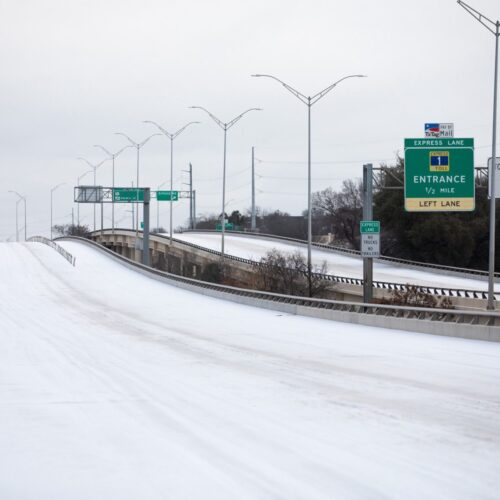

CHAMPAIGN, Ill. (Chambana Today) — As the massive Winter Storm Fern swept across much of the eastern half of the US this weekend, radio once again found itself operating in its most familiar role: a resilient, always-available source of information and continuity as power outages, travel disruptions, and emergency declarations spread state by state.
An estimated 245 million people across 40 states were in the storm’s projected path as snow, ice, and freezing rain combined to create hazardous conditions. More than 844,000 customers across the South were without electricity as of Sunday morning, according to PowerOutage.us. As utilities warned of prolonged restoration timelines and cell and broadband service interruptions mounted in harder-hit areas, the most dependable connection during the storm came not through a phone or a smart speaker, but through the car radio.
The moment underscored a growing industry concern: while car radios remain a primary access point during emergencies, several automakers continue to explore dashboard designs that deprioritize or remove traditional broadcast reception altogether; an approach increasingly at odds with how audiences actually rely on radio when conditions deteriorate and other networks fail.
Behind the scenes, the storm also put broadcast engineers on the front lines. As ice accumulated on transmission towers and temperatures dropped into the single digits, engineers across affected regions monitored signals, generators, and STL paths to keep stations on the air.
In Nashville, the storm disrupted, but couldn’t cancel, one of radio’s most enduring institutions. The Grand Ole Opry canceled its Saturday, January 24, live show and suspended Opry House tours due to safety concerns. However, the Opry chose to preserve its uninterrupted broadcast history by shifting to a radio-only presentation on WSM-AM.
At the federal level, the storm also triggered formal emergency communications protocols. On January 23, the Federal Communications Commission activated its Disaster Information Reporting System in coordination with FEMA in response to Fern. The activation spans wide portions of Alabama, Georgia, Kentucky, Mississippi, North Carolina, South Carolina, Tennessee, and Virginia, with daily reporting required until the system is deactivated.
As millions of Americans faced blackouts, icy roads, and canceled events, radio’s ability to operate independently of broadband networks once again moved from abstract value proposition to lived reality.