


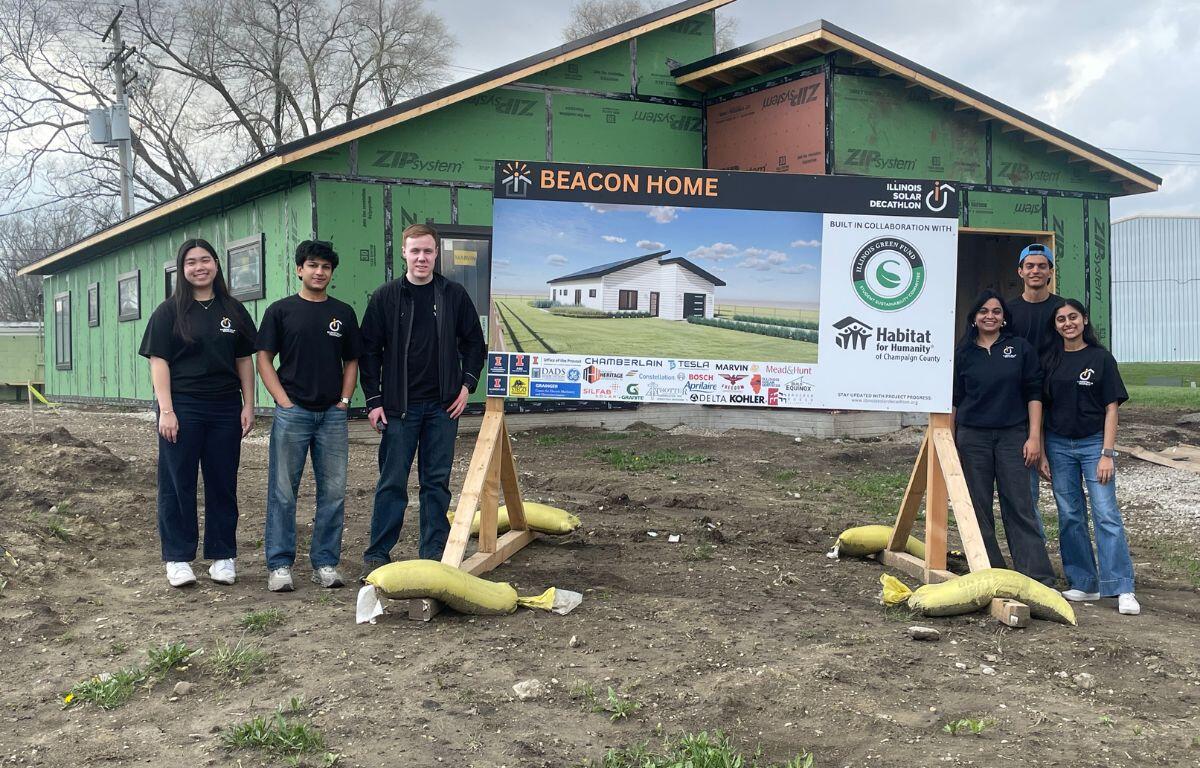

RANTOUL, IL (Chambana Today) — A group of University of Illinois students is turning classroom concepts into real-world impact by building a net-zero home designed to be both sustainable and affordable.
The student-led project, known as “Beacon,” is part of a larger effort to not only construct energy-efficient housing, but to help revitalize an entire neighborhood in Rantoul. The home will generate more energy than it consumes, using solar power and all-electric systems.
“We’re not just building a house,” said Ehauna Jain, a senior in civil and environmental engineering and president of the student organization leading the project. “We’re learning hands-on, giving back to the community and creating something that’s sustainable and impactful.”
Students from multiple disciplines — including civil engineering, construction management and landscape architecture — are collaborating on the project, gaining experience that extends beyond the classroom.
“Normally in class, we focus on theoretical knowledge,” said graduate student Vijeed Bharambe, who is studying energy systems engineering. “Here, we’re working directly with contractors and seeing how a project actually comes together.”

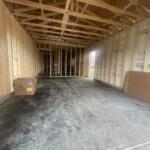

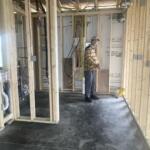
The home is being built in partnership with Habitat for Humanity, which will select the family who ultimately moves in. Organizers say the goal is to combine affordability with cutting-edge sustainability.
“We want to show that energy efficiency doesn’t have to mean expensive,” said marketing director Jamane Tong. “By using solar and all-electric systems, we’re trying to reduce long-term utility costs for the family.”
Project leaders say the effort goes beyond a single home. The team has already subdivided nearby land and is planning additional builds, with the long-term goal of creating a fully sustainable, community-oriented neighborhood.
Etienne Sirois, the project manager and a landscape architecture student, said planning ahead is key. “We’re building this house, but we’re also thinking about what comes next — how we can continue to expand and make a bigger impact.”
Faculty advisor Mark Taylor, an associate professor in architecture, said the project builds on years of student-led design and construction initiatives. “What started as a design exercise has evolved into students continuing to build in communities and make a difference,” he said.
Students also acknowledged challenges in making sustainable housing more widely accessible, noting that cost and availability of materials remain barriers.
“The main issue is scalability,” said construction management lead Amrit Agarwal. “These technologies exist, but they’re not always easily accessible to the average consumer. That’s something that needs to change.”
Still, the team remains optimistic that projects like Beacon can help push the industry forward — and inspire broader adoption of renewable energy solutions.
“We’re trying to prove that sustainable housing can be practical, affordable and beneficial for everyone,” Jain said.
Mihika Shah, a master’s student majoring in construction management says, “For me, it’s about seeing something go from an idea to reality. That’s what I was looking for in this experience—building connections, understanding how construction actually works on-site, and watching what we design come to life.”