



CHAMPAIGN, IL (Chambana Today) — The Illinois Department of Labor and the University of Illinois Urbana-Champaign held a discussion Thursday on the status of pay equity in Illinois, highlighting data collected under the Illinois Equal Pay Act and examining wage disparities across the state.
The United States passed a federal Equal Pay Act in 1963. The Illinois Equal Pay Act was passed/became effective in 2003. The Illinois Equal Pay Act has been amended since it became effective, including in 2019, 2022 and 2025.
Unlike anti-discrimination laws, which broadly cover employment practices, the Equal Pay Act focuses specifically on wages, asking employers to justify any differences. A key 2019 amendment also banned employers from asking job applicants about their current salaries, a practice known to perpetuate pay inequities.
Since 2022, Illinois has required large employers with 100 or more employees to submit detailed pay data to the state, including demographic information such as sex, race, and seniority. The initiative, considered highly progressive nationally, allows researchers to examine pay at the individual employee level—a step beyond federal reporting requirements.
“This approach allows the Department to truly assess equity and understand where gaps persist,” said Stephanie Fortado, speaking on behalf of Dr. Robert Bruno, one of the lead researchers on the project. “It’s a foundation not just for assessment but for meaningful action.”
Dr. Tingting Zhang, a University of Illinois researcher who analyzed the data, reported that the findings showed Illinois performing better than federal statistics suggested. After controlling for factors such as job title, geographic location, and years of service, the study found that gender pay gaps averaged six to eight percent, while racial disparities were around 15 percent.
“The data showed that disparities were concentrated among lower-wage positions, particularly craft workers,” Dr. Zhang said. “Higher-earning positions reached near parity, but we now have a clearer picture of where enforcement and policy focus is most needed.”
Officials said the data also highlighted the effectiveness of Illinois’ recent policies aimed at increasing pay transparency. Beginning January 1, 2025, employers with 15 or more employees have been required to post pay and benefits information in job postings—a measure that has been well-received by workers, according to the Department of Labor.
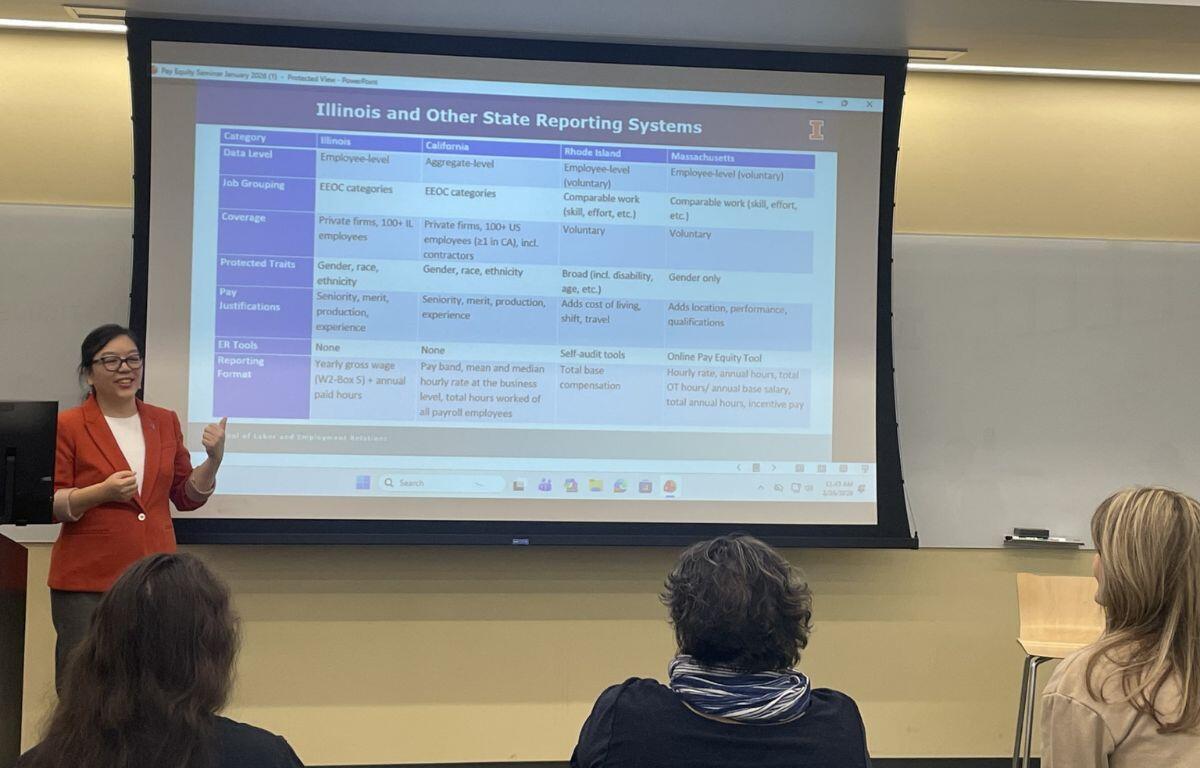
Researchers also compared Illinois’ reporting requirements with other states. California collects similar pay data but only at an aggregate level, not at the individual employee level. This granular Illinois data allowed researchers to assess actual pay equity for employees rather than rely on averages or estimates.
“The collaboration between the Department of Labor and the University has been invaluable,” Fortado said. “It has provided rigorous analysis and practical guidance to improve pay practices across the state.”
The panel discussion also explored how Illinois’ approach could serve as a model nationally. Officials noted that while some gaps remain, particularly in lower-wage and craft positions, Illinois has made measurable progress in narrowing gender and racial disparities, thanks in part to the legal framework and the state’s proactive data collection.
Dr. Zhang concluded, “The results show that focused legislation, combined with detailed data analysis, can make a real difference. We now have evidence to guide policy decisions, enforcement priorities, and future research to continue improving pay equity in Illinois.”