




CHAMPAIGN, IL (Chambana Today) — Nonprofits across east central Illinois have a new opportunity to strengthen their operations as the Community Foundation of East Central Illinois opens its annual capacity-building grant cycle, offering funding aimed at helping organizations grow, adapt, and better serve their communities.
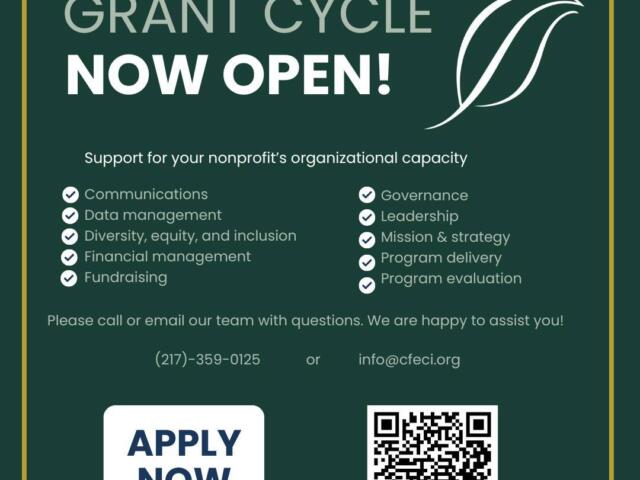
The grant cycle, which opened May 1 and runs through May 31, will distribute up to $60,000 across the region, with individual awards of up to $5,000 available to eligible 501(c)(3) nonprofits. The funding supports organizations in nine counties, spanning both rural and urban communities.
Foundation leaders say the focus of the grant is not on launching new programs, but on strengthening the internal systems that allow nonprofits to operate effectively over time.
“These are the kinds of projects that keep organizations running and growing, but they’re often the hardest to fund,” said Executive Director Allison Winter. “We’re talking about things like strategic planning, communications, fundraising infrastructure, and professional development. It’s about building a stronger foundation so nonprofits can continue to deliver on their mission.”
To hear the entire interview, click here: Focus – CFECI Capacity Building Grant Cycle by Illini Media Group
The funding is made possible through donor contributions and endowed funds managed by the foundation, with additional support directed specifically toward capacity-building efforts. Winter emphasized that the grants are intentionally flexible, allowing organizations to address a wide range of operational needs. “We really want nonprofits to think about what will move them forward,” she said. “What’s that next step that you can’t quite get to without some extra support? That’s where this funding can make a difference.”
The initiative is supported by the foundation’s Center for Nonprofit Excellence, which provides training and technical assistance to organizations throughout the region. Director Caitlyn Kurtz said the center plays a key role in helping applicants navigate the process and submit strong proposals. “We always encourage nonprofits to reach out early,” Kurtz said. “A lot of organizations don’t have dedicated grant writers, and that’s okay. We’re here to answer questions, help clarify ideas, and make sure applicants feel confident in what they’re submitting.”
Kurtz said strong applications typically include clear, detailed budgets and a compelling narrative that explains both the organization’s mission and how the requested funding will advance it. “We want to see that evidence of impact,” she said. “Assume the people reviewing your application may not be familiar with your organization. Be clear about who you serve, what you do, and how this project will help you do it better.”
Applicants are also encouraged to demonstrate how their projects will contribute to long-term sustainability. Rather than funding one-time expenses with limited impact, the selection committee prioritizes projects that strengthen organizations over time. “We always look at this through a sustainability lens,” Kurtz said. “How is this investment going to help the organization continue to operate and thrive, not just for a year, but into the future?”
Winter noted that this often means thinking carefully about ongoing costs associated with certain projects, such as software subscriptions or new systems. “If you’re asking for something like a donor database, for example, you need to show how you’ll maintain that going forward,” she said. “Maybe you need help getting started, or maybe you need training to use something you already have more effectively. Those are great uses of this funding.”
The foundation also stresses the importance of specificity and transparency in grant proposals. Vague or incomplete applications are less likely to succeed, while detailed and thoughtful submissions stand out to reviewers. “If someone just says, ‘We need $5,000,’ without explaining why, that’s not going to be compelling,” Winter said. “But if you clearly outline what you need, how much it costs, and how it will help your organization, that tells a much stronger story.”
The review process is conducted by a committee of community members representing a range of backgrounds and perspectives. Foundation staff provide guidance during the application phase but do not vote on funding decisions. “It’s really important to us that this is a community-driven process,” Winter said. “The committee takes that responsibility seriously and works to be thoughtful and inclusive in how funds are distributed.”
Because the foundation serves a diverse region, applications may reflect a wide variety of needs depending on location and community context. “What a nonprofit in Champaign-Urbana needs might look very different from what’s needed in a smaller rural community,” Winter said. “That’s part of what makes this process so interesting. We get to see the different ways organizations are addressing challenges across the region.”
Past grants have supported a range of creative and impactful projects. One example included funding for a nonprofit in Coles County that requested seeds to grow food for its community, helping address food insecurity while building a sustainable resource for future harvests. “It was a unique request, but it was very well thought out,” Winter said. “They showed how it would meet an immediate need and continue to benefit their community in the long term.”
The grant is open to nonprofits across sectors, including health and human services, education, arts and culture, environmental initiatives, and more. However, projects must demonstrate a broader community impact. “If an application is focused only on serving a very limited group, it may not be as competitive,” Winter said. “We’re looking for projects that extend beyond a single organization’s internal audience and benefit the wider community.”
Foundation leaders say they hope nonprofits of all sizes will consider applying, while also recognizing that newer organizations may still be building the experience needed to identify their capacity needs. “We don’t want to discourage anyone,” Kurtz said. “If you’re unsure, reach out and talk to us. Even if this isn’t the right fit, we can help guide you to other opportunities.”
In addition to providing funding, the foundation sees the grant cycle as an opportunity to connect with nonprofits, learn about their work, and support their development. “Every year, it’s exciting to see the ideas that come in,” Winter said. “This is a chance to invest in the people and organizations that are making a difference every day in our communities.”
This summer’s final funding effort will highlight the untold story of the Potawatomi Trail of Death, honoring the forced removal of Indigenous people from their homeland while emphasizing their resilience today. Events will include a June 21 gathering at Homer Lake, a July celebration at Prairie Walk at Buffalo Trace, and lectures later that month, offering the community opportunities to learn, reflect, and engage.
The Capacity Building Grant Cycle is now open. For more information on the grant opportunities, click here: Grant Opportunities – Community Foundation of East Central Illinois. Any questions, call (217)-359-0125 or email info@cfeci.org.